
The Central Wasatch Symposium

Join us for the 2026 Central Wasatch Symposium, happening January 8th and 9th at Millcreek City Hall — Get tickets here!
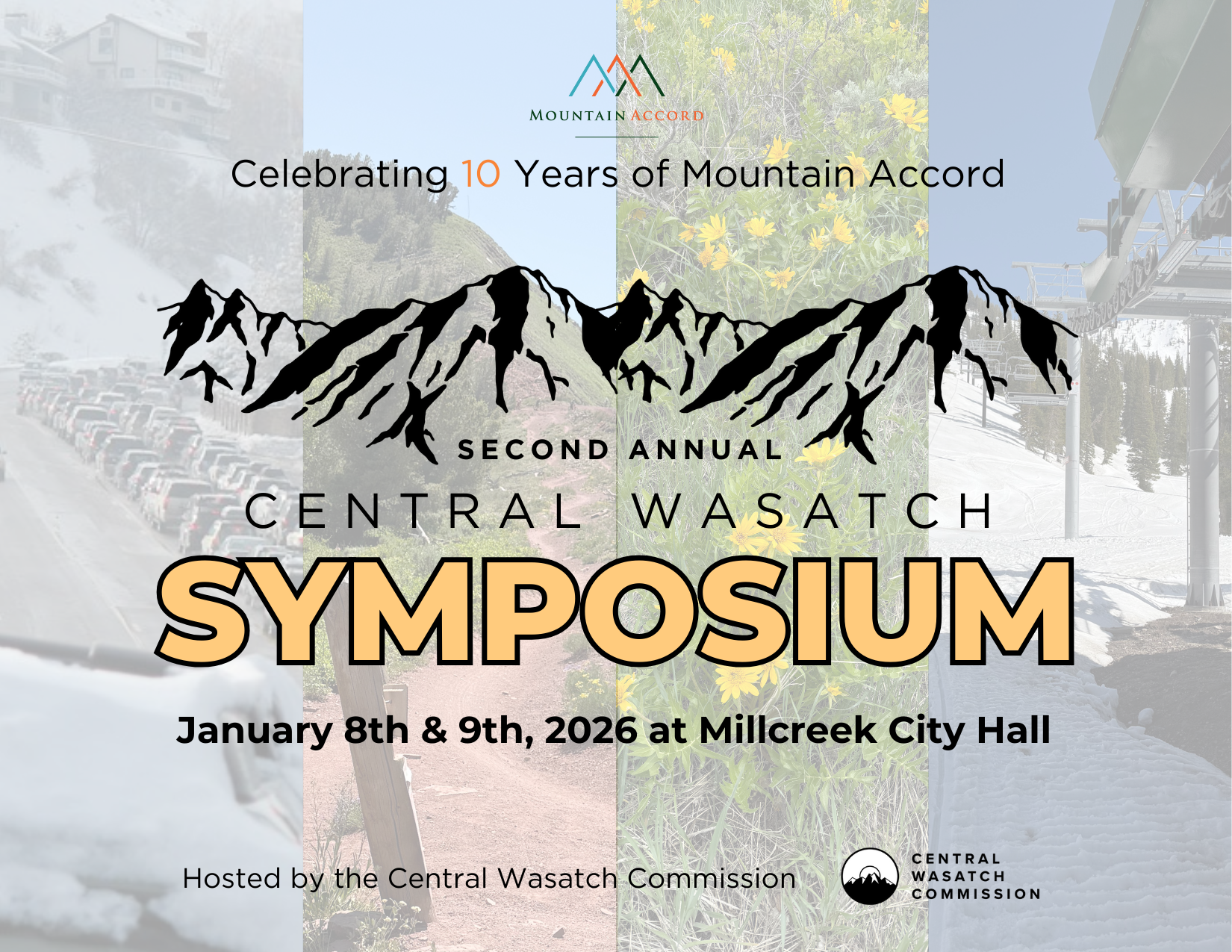

Back for the second year, the Central Wasatch Commission will host the Central Wasatch Symposium, a conference-style event bringing together various interests and stakeholders in the Central Wasatch for two days of expert panels, interactive workshops, and networking. The Symposium will take place on January 8 and 9, 2026, at Millcreek City Hall.

Thursday, January 8th, 10:00am-5:30pm (doors at 9:00am)
Friday, January 9th, 9:00am – 3:00pm (doors at 8:00am)

This year’s theme is “Celebrating 10 Years of Mountain Accord.” The Accord was signed in July 2015. Since then, the importance of this founding document has grown in tandem with increasing pressures on the mountains. At the Symposium, we will examine the accomplishments of the past 10 years, consider the mountains’ changed and changing needs since the signing, and look ahead to the 2034 Olympics and beyond, asking: What’s next for the Central Wasatch?


powered by Advanced iFrame

Keynote Speaker — Darren Parry

Darren Parry is the former Chairman of the Northwestern Band of the Shoshone Nation and an influential voice in Native American leadership, history, and environmental stewardship. He serves on the Board of Directors for Utah Humanities and PBS Utah. Darren earned his Bachelor’s Degree in Education from Weber State University and, in 2024, received an Honorary Doctorate in Education from Utah State University.

He is the author of The Bear River Massacre: A Shoshone History and Tending the Sacred: How Indigenous Wisdom Will Save the World. He teaches in the Environment, Society and Sustainability department at the University of Utah and lectures nationally and internationally on Native American history, Indigenous perspectives on sustainability, and climate resilience. In recent years, he has spoken at institutions including Harvard University and the University of Copenhagen, sharing Indigenous insights on climate, environment, and land stewardship.

Darren’s work centers on ensuring that the stories, wisdom, and sacrifices of those who came before are honored and remembered, and that Indigenous knowledge continues to inform solutions for a sustainable future.

Ticket Pricing

$50, general entrance + food and drinks + access to all breakout sessions.
$10, student entrance + food and drinks + access to all breakout sessions.
$75, general entrance + tabling expo table reservation + food and drinks + access to all breakout sessions.

Free and discounted tickets available to anyone who makes the request.

Please email samantha@cwc.utah.gov to purchase a tabling ticket, a student ticket, or to request free or discounted tickets.

Parking at Millcreek City Hall is free.

Space at the Symposium is limited! Reserve your spot now. Get tickets.

Parking and Transportation
Venue: The event will be at Millcreek City Hall, which is on 1330 E. Chambers Avenue (3205 South) in Millcreek.

Parking: There is free parking available at the venue, but it may fill up. In the event that the onsite lots are full, you may park for free in the lot across the street at the Canyon Rim Center on the southwest corner of 3300 South and 1300 East (at the site of the old Millcreek City Hall), or at the dental office across the street to the east of the venue. There is a map attached for your reference.

Transit or Bike: We encourage you to use transit to reach the event. UTA routes 33, 213, and 220 all have stops within one block of the event. Each stop is about a 3-5 minute walk from the venue. If you’d like to bike to the venue, there are bike racks on site and we will have limited space to hold your helmet and belongings at the check-in table.

Event Program

Click here to view the program as a PDF


2026 Symposium Abstracts, Talks, and Slides

Advancing Watershed Health: The 2025 Salt Lake County Integrated Watershed Plan –  by Robert Thompson, Lily Wetterlin and Arianna Mason

Click here to listen to the talk
Click here to view the slides

Abstract

Salt Lake County’s Watershed Planning & Restoration Program, with support from SWCA, continues its legacy of environmental stewardship with the development of the 2025 Integrated Watershed Plan (2025 IWP), a comprehensive strategy to protect and enhance water quality within Salt Lake County. Building on decades of watershed planning, the 2025 IWP utilizes the U.S. Environmental Protection Agency’s nine-element watershed planning process. The plan assesses current watershed conditions, identifies priority water quality concerns, and develops actionable implementation activities to address pollutants, habitat degradation, hydrologic modifications, and other stressors across Salt Lake County. Key goals include reducing point and nonpoint source pollution, enhancing public outreach and education, implementing affordable management strategies, protecting critical habitats, maintaining adequate instream flows to Great Salt Lake, and securing funding through adaptive planning and progress monitoring. The 2025 IWP represents a consensus-driven, science-based framework to restore and sustain watershed health for Salt Lake County’s communities and ecosystems. This presentation will discuss the approach to the 2025 IWP and implementation activities expected from this planning effort.

Biography

Robert (Bob) Thompson is the Watershed Section Manager for Salt Lake County Flood Control Engineering, overseeing the Watershed Planning and Restoration, Stream Gauging, and Stormwater Programs. A licensed professional geologist in Utah, he specializes in fluvial geomorphology and has studied Utah’s rivers and hydrology for 28 years. His expertise includes Clean Water Act policy, field data collection, GIS/database development, riparian restoration design, and project management.

Lily Wetterlin is a water quality scientist at SWCA Environmental Consultants, where she leads watershed planning initiatives and conducts water resources and environmental investigations throughout the Intermountain West. She brings a strong analytical background in analyzing and interpreting water resources data, leveraging this expertise to develop insightful analyses and effective planning strategies.

Arianna Mason is a water resource specialist and project manager at SWCA Environmental Consultants. With a background in water quality and water resources management, Arianna has spearheaded numerous projects as a project manager, technical lead, and data manager/analyst. Her expertise lies in developing comprehensive watershed plans, which are vital for addressing water quality issues and implementing effective restoration and protection strategies. Her work not only supports the development of effective watershed plans but also fosters stakeholder engagement and promotes a culture of continuous improvement in water resource management.


The Evolution of Skiing in the Wasatch – with Caroline Gleich, Andrew Mclean,  Ayja Bounous, Elizabeth Kimball

Click here to listen to the talk

The Evolution of Skiing brings together a mix of professional skiers, activists, authors, and a nonprofit leader to talk about what the Central Wasatch has meant to their lives. Each panelist will share their own path into skiing and how time in these mountains shaped them, sometimes in ways they didn’t expect. They’ll touch on the changes they’ve seen in the Wasatch—good and bad—and what they hope the next decade might look like. Above all, the conversation is meant to spark a sense of responsibility and curiosity about how we can all support the place that gives so much back.

Panelists

Caroline Gleich, Professional Skier; Andrew McLean, Backcountry Guide and Author; Ayja Bounous, Author; Junior Bounous, Former Snowbird Mountain School Director; Elizabeth Kimball, Executive Director of Wasatch Adaptive Sports.

Facilitator

Wil McKay, Central Wasatch Commission Communications Director


Bonanza Flat Parking and Transit Data –  by Johnny Wasden of Park City Municipal Corporation

Click here to listen to the talk

Abstract

Bonanza Flat is one of the most popular summer hiking spots in Utah that’s so close to Utahs largest city and we’ve seen the area get consistently overwhelmed by cars, traffic, and parking demands and like many of the well loved places in Utah and elsewhere, we’re seeing greater need to implement management strategies to ensure safety, reasonable access, and enjoyment of these special locations. Like many similar solutions for these challenges, parking is at the heart of these transportation strategies. By implementing paid parking, we are controlling the demand by discouraging single occupancy vehicles, encouraging parking space turnover, and promoting/providing alternative modes of getting to the destination. The parking rates, timing, and kickoff were determined based on years of area usage data, comparative data to our current parking programs in Park City, as well as models built to fund the alternative access options.

The rates will follow a “peak demand” model at $5/hr M-F then $8/hour Sat-Sun. The paid parking plan will be directly supporting a dedicated transit line to the area from old town Park City. The transit line will run about every 20 minutes with the capacity for about 10-12 people/bikes. The transit service will provide free, safe and reliable transportation to the area while reducing vehicle impacts to the narrow, steep roadways as well as reduce wait times (sitting in your car, waiting for a parking spot) that many drivers experience going to the area during peak times. That means you get on the trail faster than ever! Our new motto is Transit is your trailhead! The locals permit was born out of the concept that residents living in the 84060 area code actively pay into the $25 million dollar bond which secured and preserves this area for everyone to enjoy. While we still encourage locals to ride the shuttle up for all of the aforementioned benefits, they will have the option to obtain a parking permit and park without payment. I personally frequent the area 2 to 3 times a week in the summertime and have experience firsthand, the congestion, safety hazards, and frustration felt just trying to get out on the trails- I for one will be using this service alternatively to having to shuttle vehicles when I go mountain biking!

Biography

Johnny Wasden is the Parking Manager for Park City Municipal Corporation since 2018. Johnny got his start in the parking industry from the University of Utah in 2007 and has been hooked for nearly 18 years! The Park City parking Department is an enterprise fund which supports itself and uses excess revenues to contribute to community priorities and infrastructure improvements. The Bonanza Flat parking management strategy, paired with the Purple 9 bus route highlights a bite-sized example of implementing demand management strategies while providing free access alternatives to a large swath of users. Park City Municipal is consistently working collaboratively in-house and with vendors to solve complex transportation issues in creative, community-serving ways.


Millcreek Shuttle Feasibility Study –  by Jon Nepstad and Ryan Hunter of Fehr & Peers

Click here to listen to the talk
Click here to view the slides

Abstract

The upper portion of Mill Creek Canyon Road is currently undergoing construction that will improve roadway conditions and restructure parking. With improved roadway access on the horizon, this study aimed to determine whether shuttle service would be feasible to transport visitors throughout Mill Creek Canyon. By understanding the existing conditions, recreation patterns, and future construction, Fehr & Peers provides insight into the opportunities and challenges that come with providing shuttle service in Mill Creek Canyon.

Biography

Jon Nepstad is a Principal with Fehr & Peers in their Salt Lake City office. Jon led the original Mill Creek Transportation Study and has overseen the current shuttle study. Jon has led or been part of many studies and projects along the Wasatch Range, including extensive work in both Cottonwood Canyons. When not working, he skis, bikes, and hikes throughout Utah as much as possible. Jon also chairs the Town of Alta Planning Commission.

Ryan Hunter is a Transportation Planner with Fehr & Peers in their Salt Lake City office. Ryan was the primary analyst of the Mill Creek Feasibility Study. His previous work includes transit and visitor-use studies for clients such as UTA, UDOT, and the National Park Service. Outside of work, Ryan enjoys climbing, cycling, and bagging peaks throughout Utah.


10 Years of Mountain Accord: A Retrospective – Precipitating – with Ralph Becker, Chris Robinson, Laura Briefer, Ben McAdams

Click here to listen to the talk

Abstract

The Mountain Accord Charter was signed in Summer, 2015, and the Central Wasatch National Conservation and Recreation Area was introduced to Congress by former Rep. Jason Chaffetz in 2016. Before the Mountain Accord Charter was drafted, and before we had the language and the agreements for what would later become the CWNCRA, visionaries dreamed up an approach for the long-term protection of the Central Wasatch Mountains and the stewardship of the four interdependent systems of the Central Wasatch – the economy, recreation, transportation, and the environment. During this panel, five of those visionaries will discuss the precipitating events, the early brainstorming discussions, and the grassroots organizing that culminated in the landmark future planning process – Mountain Accord.

Panelists

Ralph Becker, former SLC Mayor and former Central Wasatch Commission Executive Director; Ben McAdams, former Salt Lake County Mayor and Former Congressman; Laura Briefer, Director, Salt Lake City Public Utilities; Chris Robinson, Summit County Councilmember

Facilitator

Megan Nelson, The Nature Conservancy and Mountain Accord Program Coordinator


Mountains and Mental Health: How Landscapes Impact Our Well-being –  by Megan Call of the University of Utah Health Resiliency Center

Click here to listen to the talk (coming soon)
Click here to view the slides

Abstract

The research on wilderness and our own well-being continues to inform us that we all benefit when we commune with and remember that we are part of nature. Recent studies indicate that viewing horizons truly invites us to view the world and ourselves more expansively; that working in and smelling soil releases the social bonding hormone oxytocin; and that being in nature not only induces the good feeling of awe, but also does many good things for our bodies. This presentation will share up-to-date research information on how engaging with wilderness and wildness impacts our mental health and provide simple strategies that can easily be implemented to connect more with the landscapes around us and simultaneously boost our well-being.

Biography

Megan Call is the Associate Chief Wellness Officer and directs the Resiliency Center for U of U Health. She is also an Assistant Clinical Professor in the Department of Psychiatry. She has research and clinical interests in promoting resilience and well-being among health providers, with a specific focus on embracing vulnerability and discomfort, incorporating informal mindfulness into everyday practice, improving communication and relationship skills, and addressing systematic change.


Processes and Impacts of Dust on Snow in the Wasatch –  by Dr. McKenzie Skiles of the University of Utah Snow HydRO Lab

Click here to listen to the talk
Click here to view the slides (coming soon)

Abstract

Seasonal mountain snowmelt from the Wasatch Mountains is the primary water source for the Wasatch Front, recharge for the Great Salt Lake, and underlies the winter sports economy sector. Adjacent to dust producing regions, including the dry lake bed of the Great Salt Lake, the snow cover is at risk of dust deposition. Deposited dust darkens the snow surface and accelerate snow melt, shifting the timing and magnitude of snowmelt, and shortening the snow cover season. The impacts of dust on snow have been well studied in the Colorado Rockies over multiple decades, whereas detailed monitoring began in the Wasatch in 2018. This presentation will summarize monitoring methods and our current understanding of dust on snow processes, impacts, and trends in the Wasatch.

Biography

Dr. McKenzie Skiles is the Director of the Snow Hydrology Research-to-Operations Laboratory (Snow HydRO Lab) at the University of Utah. Her research methods combine hydrologic modeling with multi-scale observations to understand how much water is held as snow in the mountains and how snow is changing over time. One of her main research trajectories is investigating the impacts of mineral dust and other light absorbing particles on snow in the Western US, where changing snowmelt patterns have important implications for water security, ecosystems, and economies.


Recreation, Capacity, and Stewardship: Tools for Decision-Making in the Central Wasatch –  by Dr. Clara-Jane Byle of the University of Utah

Click here to listen to the talk
Click here to view the slides

Abstract

This presentation provides an overview of carrying capacity and the Visitor Use Management Framework (VUMF) within the context of the Central Wasatch Mountains and the Mountain Accord’s long-term vision. The Accord emphasizes protecting ecological integrity, sustaining high-quality recreation opportunities, and supporting regional prosperity through an integrated, landscape-scale framework. Building on this foundation, the presentation introduces VUMF as a proactive, adaptive process grounded in natural and social science data, applicable across all visitor-based recreation settings. Key concepts of carrying capacity will be explored across ecological, social, cultural, community, and physical dimensions, emphasizing that capacity is not a fixed calculation but a reasoned determination linked to desired conditions. The presentation concludes with an overview of management tools, including reservation systems and foundational strategies to modify use, behavior, timing, location, expectations, and site resilience. Together, these elements support thoughtful, equitable, and sustainable recreation management in the Central Wasatch.

Biography

Dr. Clara-Jane (CJ) Blye is an Assistant Professor in the Department of Parks, Recreation, and Tourism at the University of Utah. CJ’s research is focused on environmental communication, policy, park management, and environmental psychology. She uses mixed methods in her research and has a strong applied focus to her work. CJ has worked with NGO’s and park agencies such as Parks Canada, BC Parks, Alberta Parks, and Ontario Parks to develop theoretical and practical research that can be used in developing policies and strategies. Currently, she is investigating the efficacy of visitor pledges in British Columbia, Canada investigating regenerative tourism programs in GNAR communities across the mountain west.


10 Years of Mountain Accord: A Retrospective – A Conversation with Mountain Accord Leadership – with Jeff Edwards, Joan DiGiorgio, Brad Barber, Laynee Jones

Click here to listen to the talk

Abstract

The Mountain Accord process was a collaborative effort that endeavored to make integrated decisions regarding the future of Utah’s Central Wasatch mountains. Mountain Accord brought together over twenty organizations that were committed to planning collaboratively and regionally to ensure that the Wasatch mountains are resilient in the face of future challenges. The work of Mountain Accord was built around a systems approach to planning — four System Groups, corresponding to Mountain Accord’s four primary goals – environment, recreation, transportation and economics formed and were populated with policy-level and technical subject matter experts, community and advocacy groups, and staff from agencies and organizations with an interest or mandate related to that system. Each System group developed a Vision statement that articulated, in a broad sense, a shared description of the desired future state of that System in the Central Wasatch. Ten years later, the leaders of the Mountain Accord process have gathered for this panel discussion centered on the legacy of Mountain Accord, and the enduring lessons that we can use to address current issues in the Central Wasatch Mountains.

Panelists

Joan Digiorgio, Environment System Group Chair; Jeff Edwards, Economy System Group Chair; Brad Barber, Recreation System Group Chair

Facilitator

Laynee G. Jones, Mountain Accord Program Director


Resilient Ice: How Rock Glaciers Will Shape the Future of Water in the Wasatch –  by Scott Hotaling of Utah State University

Click here to listen to the talk
Click here to view the slides (coming soon)

Abstract

Climate change is dramatically altering mountain environments in the western USA. In the Wasatch, peak snowpack has declined by ~20% since 1980 due to a warming-induced shift in precipitation. While total precipitation has been largely unchanged, more precipitation is falling as rain versus snow. However, snow is not the only frozen water in the Wasatch. Utah is home to ~800 rock glaciers—large masses of debris-covered ice that flow downhill. Largely overlooked until recently, most of Utah’s rock glaciers occur in the Wasatch and Uinta Mountains. In this presentation, I will speak primarily to the CWC’s environment focus area by discussing how the Wasatch is changing, what we know about rock glaciers, and how my team is working to understand how rock glaciers will influence the future of water and biodiversity in the Wasatch. In addition to discussing the science, I will also share how we are communicating our work and how the development of a new Center at Utah State University—the Center for Mountain Futures—will hopefully provide the necessary infrastructure to support this work for the long-term.

Biography

Scott Hotaling is an Assistant Professor in the Department of Watershed Sciences at Utah State University where he leads the Climate Change in Mountains Lab. He’s also the Climate Resiliency Specialist for Utah State University Extension. He holds a PhD in Biology from the University of Kentucky and he joined the faculty at Utah State University in 2022. He has a long history of interdisciplinary research to understand how mountain systems are changing in the western USA and what those changes mean for biodiversity, water, and people. In addition to research, he’s also a skilled science communicator. Most recently, he started the Mountain Futures YouTube channel to connect with a global audience about how mountains are changing around the world (https://www.youtube.com/@mountainfutures/).


Stewarding a Growth Engine: Outdoor Recreation, the Central Wasatch, and Utah’s Economy –  by Dr. Jordan W. Smith of Utah State University

Click here to listen to the talk
Click here to view the slides

Abstract

Outdoor recreation is no longer a “nice-to-have” in Utah—it is a core driver of the state’s economic vitality, quality of life, and global brand. This presentation will summarize the latest estimates of outdoor recreation’s economic contributions to Utah, highlighting spending, jobs, and tax revenues, with a particular focus on the Central Wasatch Mountains. I will compare Utah’s outdoor recreation economy to peer states to demonstrate why Utah, more than most places, must actively steward its recreation resources. Using case examples from the Central Wasatch, I will illustrate how public and private investments in transportation, trail systems, resort infrastructure, and visitor services can simultaneously support local businesses, protect sensitive landscapes, and enhance resident well-being. Finally, I will discuss how rapid advances in technology—including artificial intelligence, new monitoring tools, and data-driven planning platforms—are reshaping both visitor behavior and management capacity. I will conclude by outlining opportunities for future collaborative efforts among agencies, local governments, nonprofits, and the private sector to sustain and grow an outdoor recreation economy that remains both competitive and conservation-minded.

Biography

Dr. Jordan W. Smith is a Full Professor and Director of the Institute of Outdoor Recreation and Tourism at Utah State University, where he leads research and extension programs focused on the economics and governance of outdoor recreation and public lands. His work integrates econometric modeling, geospatial analytics, and emerging technologies—including AI-enabled decision-support tools—to quantify how recreation contributes to local and state economies and to inform investment and stewardship decisions. Dr. Smith has led interdisciplinary teams supporting policy and planning across millions of acres of public lands in the Intermountain West and has played key roles in initiatives such as the Utah Outdoor Recreation Strategic Plan and the Gateway and Natural Amenity Region (GNAR) Initiative. He regularly collaborates with state agencies, local governments, and industry partners to translate data into actionable strategies that sustain both vibrant recreation economies and healthy landscapes.


Transit Building in the Wasatch Back – Caroline Rodriguez & Christopher F. Robinson

Click here to listen to the talk

Abstract

High Valley Transit is one of Utah’s newest transit districts. It originated as a wing of the Summit County government and has since expanded to serve Summit County, parts of Park City, and is the only transit connection bridging Salt Lake and Summit Counties. Caroline Rodriguez and Chris Robinson will talk about the genesis of High Valley Transit beginning with when it was just a “hair-brained idea” to when HVT was operating out of temporary tents and now as a permanent and bustling transit hub.

Biography

Caroline Rodriguez is the Executive Director of High Valley Transit, the Wasatch Back’s first regional public transit district. Established in January 2021 by Summit County, HVT was created to provide equitable transit solutions across the region. Under Caroline’s leadership, the agency built a comprehensive system from the ground up, completely fare-free: local, express, and regional fixed-route; on-demand Microtransit (“Micro”) vans; and ADA-accessible Valley Ride paratransit. High Valley Transit’s signature Micro service—custom-branded, app-based vans that dynamically match riders—is now an essential mobility offering in Summit and Wasatch counties. By January 2025, HVT had delivered approximately 3.3 million fixed-route rides and 1.0 million Micro rides, supported by more than 146,000 app subscribers. Prior to her tenure at High Valley Transit, Caroline was Summit County’s first Director of Regional Transportation Planning—where she launched Summit Bike Share (the nation’s first fully electric bike-share system), defined the County’s transportation goals, and secured and managed more than $80 million in discretionary grants. She began her career as a transit planner and project manager for a national consulting firm, working with DOTs across Florida, Tennessee, and Mississippi, and co-authored major research on coordinated human-services transportation. Caroline holds a BA from the University of Texas at Austin and an MCP from Boston University. She resides in Francis, Utah with her husband and three daughters.

Christopher F. Robinson is the CEO and co-owner of The Ensign Group, L.C., which through its affiliates owns, operates, leases, and/or manages large tracts of private and public land located in Utah, Idaho, and Wyoming, and used for production agriculture, mineral and resource development, wildlife values, water resources, environmental values, real estate investment, and/or real estate development. Chris is an elected Member, Summit County Council (2009 through present); a member of the Executive Committee and Vice-Chair, Mountain Accord (2014 to 2016); a member of the Board of Directors, a member of the Utah Local Governments Trust (2015 to present); a member of the Bureau of Land Management Utah Resource Advisory Council (January 2016 to present); a member of the Utah Advisory Board for the Sundance Institute (2017 to present); a trustee (1999 to 2002) of the Salt Lake Organizing Committee for the 2002 Winter Olympic Games and Vice-Chairman of Audit Committee; a trustee and currently Vice-Chair of the Utah Board, The Nature Conservancy (1996 to present);. Chris is married to Rochelle Allen Robinson, and they are the parents of four children. He received an Honors B.A. in Accountancy from the University of Utah (1986), and resides in Park City, Utah.


The Utah Division of Outdoor Recreation Presents: A Crash Course in the State Legislative Process – Patrick Morrison & India Nielsen

Click here to listen to the talk
Click here to view the slides

Abstract

The Utah Division of Outdoor Recreation (DOR) invites you to learn how a bill becomes a law in Utah, and where recreation fits in on Capitol Hill. After an intro into Utah’s Division of Outdoor Recreation and how it can support recreation in the central Wasatch, attendees will learn how to be involved in Utah’s legislative process from a variety of perspectives and roles. This will primarily focus on the state legislative process, but feel free to come with your questions about how to get involved at the municipal, county, or federal level. While this presentation can be related to all of the focus areas, special attention will be given to the legislative process through the recreation lens, looking at specific bills and committees who are most impactful in creating recreation policy. Attendees will leave with a solid foundation of the state legislative process, how to engage with their legislators, and how to follow key bills and committees using the website. Attendees will also learn the many ways the Utah Division of Outdoor Recreation can support their recreation projects and management.

Biography

Patrick Morrison is a Recreation Program Director with the Utah Division of Outdoor Recreation. A Utah native, he is an avid climber, fly fisher, and backpacker. Before his current role, he served as Trails Director for the Cottonwood Canyons Foundation, an environmental stewardship non-profit in Salt Lake City where he now serves on the board. He is also the current Board Chair for the Salt Lake Climbers Alliance, and a member of the Central Wasatch Commission Stakeholder Council. He has a Bachelor’s degree from the University of Utah and a Master’s degree from New York University. A former political professional in New York City, the natural lands of Utah are where he belongs.

India Nielsen is a native Utahn and proud Weber State Wildcat. She joined the Utah Division of Outdoor Recreation shortly after finishing her Master of Public Administration degree with a parks and recreation focus. She served in the State Elections Office under Lt. Governor Cox for four years and loves obstacle course racing, backpacking, the Jordan River, and her rescue cat.


Wild Economics: How Preserving Land Can Help Our Recreation Industry – by Jack Stauss of Save Our Canyons

Click here to listen to the talk

Abstract

This presentation will showcase how the conservation and preservation of lands is not necessarily at odds with fostering a robust recreation economy. In fact, this presentation will show that we are able to both create a resilient future for all of the entities that exist and thrive in the Wasatch. Focus areas will be environment, economy, and by extension, recreation.

Biography

Jack Stauss moved to Salt Lake City in 2008 for the skiing and for college. Over the years he has worked on Wasatch and Colorado River conservation projects, advocating for the protection of wild places throughout the West. At Save Our Canyons, he fights for thoughtful planning of the Wasatch Range. When he’s not working, he enjoys backcountry skiing, hiking, biking, and exploring wild corners of the country and beyond.

Past Symposium Details

The Inaugural Central Wasatch Symposium, January 9th and 10th, 2025


2025 Symposium Trailer


powered by Advanced iFrame


2025 Presentation Recordings

Thursday, January 9th, 2025

Why the Central Wasatch National Conservation and Recreation Area Act – Ralph Becker

What Happens to the Water, Happens to the People – Laura Briefer; Salt Lake City Public Utilities

Uinta-Wasatch-Cache National Forest Plan 101 – Adam Shaw; Uinta-Wasatch-Cache National Forest

Preserving Utah’s Climbing Legacy – Julia Geisler; Salt Lake Climbers Alliance

The Visitor Economy in Park City and Summit County: Successes, Mitigating Impacts, and Regionality – Morgan Mingle and Becca Gerber; Park City Chamber of Commerce and Visitors Bureau

Backcountry Skiing in the Wasatch: What it is and Why it Matters – Aaron London and Will McKay; Wasatch Backcountry Alliance

An Introduction to the Biodiversity of the Central Wasatch – Mary Pendergast; Sageland Collaborative

Transportation Panel – Moderator: WFRC – Panelists: UDOT, UTA, HVT


Friday, January 10th, 2025

Mayor and City Council Member Panel – Park City, Millcreek, Salt Lake City, Sandy, Town of Alta, Town of Brighton

Ski Resort Panel – Snowbird Resort, Alta Ski Area, Brighton Resort, Solitude Mountain Resort

Forest Service NEPA and Public Participation – Lance Kovel; Uinta-Wasatch-Cache National Forest

Advancing Wildfire Mitigation and Defensible Space Initiatives in the Wasatch Partnerships and Community Engagement – Salt Lake County, Utah DNR (Division of Forestry, Fire, and State Lands), United Fire Authority

The Historical Journey and Significance of Wilderness Designations within the Central Wasatch Mountains – Spencer Shaver; Save Our Canyons

Where We Came From and What Makes an Avalanche Forecast – Caroline Miller and McKinley Talty; Utah Avalanche Center

A Crash Course in the State Legislative Process – Patrick Morrison and India Nielsen Barfuss; Utah Department of Ourdoor Recreation


“The Central Wasatch Symposium will be an opportunity for the public to engage in all the work of the Central Wasatch Commission over the course of two days.” Central Wasatch Commission Chair and Mayor of Millcreek, Jeff Silvestrini said, “It will spotlight the interdependence of the four systems of the Central Wasatch while bringing stakeholders and the public together for learning and networking. The Commission is especially pleased to welcome Terry Tempest Williams, a writer and poet with a specific connection to the Central Wasatch Mountains will provide the keynote address during this first annual event.”

The Central Wasatch Symposium will begin on January 9th, 2025 at 10:00am with a keynote address from award-winning author, environmentalist, and activist Terry Tempest Williams. Lunch will be served at 11:00am, and the remainder of the day will consist of breakout sessions until 5:00pm. There will also be a tabling expo during the lunch hour.

We pick back up on January 10th, 2025 at 1:00pm with a panel discussion with mayors from across the Central Wasatch Front and Back. The day will continue with more breakout sessions, a tabling expo in the middle of the afternoon, and will conclude with the opportunity to network with other attendees and speakers over light appetizers and live music from 5:30-6:30pm.

Keynote Speaker — Terry Tempest Williams


Terry Tempest Williams has been called a citizen writer, a writer who speaks and speaks out eloquently on behalf of an ethical stance toward life. A naturalist and fierce advocate for freedom of speech, she has consistently shown us how environmental issues are social issues that ultimately become matters of justice. So here is my question, she asks, what might a different kind of power look like, feel like, and can power be redistributed equitably even beyond our own species?

Known for her impassioned and lyrical prose, Terry Tempest Williams is the author of the environmental literature classics Refuge: An Unnatural History of Family and Place; An Unspoken Hunger: Stories from the Field; Desert Quartet; Leap; Red: Passion and Patience in the Desert; The Open Space of Democracy; F

inding Beauty in a Broken World; When Women Were Birds; Erosion: Essays of Undoing; The Hour of Land: A Personal Topography of Americas National Parks; and The Story of My Heart by Richard Jeffries, as rediscovered by Brooke Williams and Terry Tempest Williams. She has collaborated with photographer Fazal Sheikh on The Moon Is Behind Us, with artist Mary Frank on A Burning Testament, and What My Body Knows, and she wrote the introductory essay for A Wild Promise by Allen Crawford. In 2024 she wrote text to accompany woodblock prints by Gaylord Schanilec for the fine press book Oracle Bones (Red Butte Press).


Following the keynote address, Symposium attendees will have the opportunity to attend presentations, expert panels, and breakout sessions covering the following topics:

  • The Central Wasatch National Conservation and Recreation Area Act
  • The Cottonwood Canyons Watershed
  • Uinta-Wasatch-Cache National Forest Plan 101
  • Rock Climbing Across the Central Wasatch
  • The Visitor Economy in Park City and Summit County
  • Backcountry Skiing in the Central Wasatch
  • An Introduction to the Biodiversity of the Central Wasatch
  • Transportation Planning for the Central Wasatch
  • The Unique Opportunities and Challenges of Leading a City Along the Central Wasatch Mountains
  • The Current State and Future Outlook of the Ski Industry in the Cottonwood Canyons
  • Forest Service NEPA and Public Participation
  • Advancing Wildfire Mitigation and Defensible Space Initiatives in the Wasatch
  • The History and Significance of Wilderness Designations within the Central Wasatch Mountains
  • Avalanche Forecasting in the Central Wasatch Mountains
  • A Crash Course in the State Legislative Process


Event Program

Click here to view the PDF version of the program


Presentation Abstracts and Speaker Biographies

Why the Central Wasatch National Conservation and Recreation Area Act?  –  by Ralph Becker

Abstract

Mountain Accord was the culmination of three years of intense interaction seeking long-term solutions to the endless battles over the Central Wasatch Mountains, and the foundation for an agreeable solution realized in Mountain Accord continues to exist today. At the time, there were two competing objectives about what should happen in the Central Wasatch Mountains at the inception of Mountain Accord. One group was anxious to see the mountains better protected and managed for watershed protection, lands and resource management, and visitor use. The second group wanted to see transportation problems resolved for better access. Both major interests agreed on a comprehensive solution that provided the path forward that achieved their ends while respecting other interests’ needs through the CWNCRA. Today the Bill sits at the CWC. Every provision, the subject of intense debate and refinement, reflects a need of an interest or jurisdiction. Looking forward, the Central Wasatch Mountains interests face two choices: 1) continue the battles on a case-by-case basis; or 2) resolve many of the major issues through the Central Wasatch National Conservation and Recreation Area Legislation and agreeable transportation solutions as laid out by the Mountain Accord.

Biography

Ralph Becker is a 44-year resident of Salt Lake City where he served two terms as mayor (2008- 2015). He served in the Utah State Legislature as a member of the House of Representatives for 11 years (1996-2007), including five years as House Minority Leader. In 2015, Ralph served as President of the National League of Cities. In June, 2018, Ralph Becker was selected as the first Executive Director of the Central Wasatch Commission, an interlocal governmental entity consisting of elected leaders of jurisdictions with responsibilities for the Wasatch Mountains. Their mission is to coordinate and take actions to protect and administer this heavily used and prized region while respecting the many jurisdictions’ responsibilities. It is tasked with implementing Mountain Accord. In 2017, Ralph served as a Leadership in Government Fellowship with the Open Society Foundation. He speaks regularly around the world on governance and sustainability and has authored numerous publications. Prior to his legislative service, Ralph was Utah State Planning Coordinator under Governor Scott Matheson, and co-launched a consulting firm (Bear West) for 22 years specializing in community and resource management planning, environmental assessment, public lands, and public involvement. Ralph was an adjunct professor in the University of Utah College of Architecture and Planning. Ralph holds an undergraduate degree from the University of Pennsylvania, and from the University of Utah he has JD and a MS degrees. He is a FAICP planner. Ralph Becker is married to Kate Kopischke, the father of two, and grandfather. He enjoys spending his free time participating in a wide range of outdoor recreational activities.


Whatever Happens to the Water, Happens to the People  –  by Salt Lake City Public Utilities

Abstract

The mountains of the Central Wasatch provide most of the drinking water to more than 500,000 people in the Salt Lake Valley. As such, these mountains play a critical role in the health and prosperity of Utah’s most populous communities. To ensure a reliable and high-quality water supply continues for the public, the Central Wasatch watersheds are managed by multiple jurisdictions to preserve water quality and quantity. The Central Wasatch watersheds are vulnerable to degradation if not properly managed. Climate change, increasing recreational demand, development pressures, and forest health are some of the challenges facing these watersheds. At the same time, the population that depends on these water resources is increasing, Great Salt Lake is shrinking, and drinking water regulations are becoming more stringent. These factors are colliding to create vulnerabilities and risks to the water supply so many people depend upon. Laura Briefer will discuss the iterative process employed by Salt Lake City Department of Public Utilities to mitigate risks and protect watersheds and water resources in this dynamic time so that the public’s access to clean and reliable water supplies remains now and in the future.

Biography

Laura Briefer is the Director of Salt Lake City Department of Public Utilities (SLCDPU). She has served as Director of SLCDPU since 2016. Laura has worked at SLCDPU for 16 years in various areas of the organization and has devoted a 29-year career in natural resource, environmental, and public policy professions in the public, private, and non-profit sectors. She holds a bachelor’s degree in Environmental Studies from the University of California at Santa Barbara, and a Master of Public Administration from the University of Utah. Laura is a co-author of several peer-reviewed published papers alongside Utah’s academic institutions, focused on water resources, climate change, and watershed management. She serves on local and national boards, including the Provo River Water Users Association, National Association of Clean Water Agencies (https://www.nacwa.org/), the national Water Research Foundation, (https://www.waterrf.org/), and the Utah Water Task Force.


Wasatch-Cache National Forest Plan 101  –  by Uinta-Wasatch-Cache National Forest

Abstract

The Wasatch-Cache Forest Plan provides strategic and programmatic guidance and management direction for the Wasatch-Cache National Forest. This presentation will describe the long-term vision and strategy to guide future on-the-ground activities, and highlight the sideboards and constraints within which the Forest makes project decisions. The discussion will include some history of how the Wasatch-Cache Forest Plan was developed, the legal and regulatory framework in which it functions, and how the Forest Plan informs project-level NEPA decisions. Some time will be provided for questions and answers about the Forest Plan and its use.

Biography

Adam Shaw is the Acting District Ranger for the Salt Lake Ranger District, Uinta-Wasatch-Cache National Forest. He has spent much of his 20-year federal career in NEPA and Planning roles. He has led and worked with interdisciplinary teams completing project and forest planning across many resources and program areas. Adam is a Utah native, born and raised in the Wasatch. Outside of work he enjoys traveling and exploring the world with his family, cooking and eating delicious food, skiing, mountain biking, hiking, camping, and fishing.


The Visitor Economy in Park City & Summit County: Successes, Mitigating Impacts, & Regionality  –  by Park City Chamber of Commerce and Visitors Bureau

Abstract

Park City & Summit County’s visitor economy is the primary driver for the local economy, generating $2.2 billion in economic impact and directly supporting almost 30% of all jobs in the county. However, this robust economic engine doesn’t come without some unique pressures. Presenters will provide an overview of Summit County’s visitor economy and discuss the nuances of the positive and negative impacts of a robust visitor economy. Topics covered include: An outline of the recent Park City Tourism Economy Impact Study results Positive effects of tourism dollars in the local community The realities of a large workforce with limited affordable housing options How you shape responsible visitation when visitors don’t care about jurisdictional boundaries. Creating plans to mitigate impacts using Sustainable Tourism frameworks including: Regional transportation opportunities for workforce and guests Affordable housing Natural resource preservation and amenity demand controls.

Biography

Becca Gerber is the Senior Director of Community & Government Affairs. Growing up in Park City inspired Rebecca’s love of community and the outdoors. She’s managed ski shops across Utah and Colorado, always finding time to mountain bike, hike, hit the slopes, and explore. A political science graduate of the University of Utah, Rebecca served on the Park City Council for eight years prior to joining the Chamber, advocating for family and worker issues such as childcare and affordable housing. A mom raising two young children, she continues working to balance Park City’s economy and environment, serving on the boards of Mountainlands Community Housing Trust, the Hive and the Early Childhood Alliance Steering Committee. Why I love Park City: “Park City is home! I love being 5 minutes from two world class ski resorts and having 400 miles of trails outside my door.” Morgan Mingle is the Director of Sustainable Tourism. Hailing from Texas, Morgan’s work in wildlife research and tourism inspired her to pursue sustainability studies, earning a Master’s in Sustainability from Harvard. She directs the Chamber’s sustainability programs, such as our sustainable tourism grant process and the strategic implementation of our Sustainable Tourism Plan. Off hours, you’ll find Morgan stopping at local ice cream shops while on all-day bike rides, hiking, cooking Cajun food, or petting dogs. Doing puzzles while listening to records is a favorite way to unwind. What I love about Park City: “I love grabbing an early coffee and strolling as the town wakes up. The transition from peaceful to lively as Main Street starts opening is beautiful.”


Preserving Utah’s Climbing Legacy  –  by Salt Lake Climbers Alliance

Abstract

Little Cottonwood Canyon Climbing Area Receives Historical Nomination – 1st Climbing Area in the Nation Climbing is part of what it is to be a Utahn and is part of our legacy that is enjoyed still today by a growing new generation of climbers. Along with the increasing interest of rock climbing comes the challenge and responsibility to preserve and protect these areas with rich historical value. Because of advocacy and care through the community of climbing, these experiences from early to modern day have not changed much. As climbing evolves, the routes and the passion for where we climb remain the same.

Biography

Julia Geisler is the Executive Director of the Salt Lake Climbers Alliance whose mission is to engage as an advocate to protect outdoor climbing access and as a steward to maintain sustainable climbing resources in the Wasatch and surrounding regions.


An Introduction to the Biodiversity of the Central Wasatch – by Sageland Collaborative

Abstract

An introduction to the CWC’s online Environmental Dashboard will be provided along with a summary of the biodiversity of the Central Wasatch through a description of species representatives from each taxa (e.g. native plants, mammals, insects, herpetofauna, and fish). A bingo card or interactive tool for the audience will be provided in some form. A message on the importance of the CWC and Environmental Dashboard and information on ways to engage in community science in the Central Wasatch will be included.

Biography

Mary Pendergast is a Ph.D. Ecologist working at Sageland Collaborative, a conservation science non-profit based out of Salt Lake City. She has 20 years of experience in ecological and biological studies, research project management, and strategic planning in support of wildlife conservation, habitat restoration, and collaborative landscape-scale planning processes. In her role at Sageland Collaborative, Dr. Pendergast designs, manages, and acquires funding for multiple grant supported conservation programs with government and academic partners. She presents research, develops manuscripts for publication, and produces and/or reviews conservation analyses in preparation for species status reviews, listing petitions, and land management plans. Dr. Pendergast also engages in and oversees data collection efforts such as graduate student internships and community science programs. Mary has served on the board of the Utah Chapter of The Wildlife Society as well as on the Tracy Aviary Conservation Science Committee and Board of Trustees. Additionally, Dr. Pendergast teaches select ecology and field biology courses at Westminster College.


Canyons Transportation Planning Panel

Abstract

Nichol Bourdeaux has over 20 years of experience working in communications and government relations. Before serving in her current position at UTA, Ms. Bourdeaux served as the Deputy Chief of Staff for Mayor Ralph Becker, in Salt Lake City. Prior to that, she served as the Deputy Director of Housing and Neighborhood Development for Salt Lake City Corporation. She began her career in communications working for sporting and news affiliates. Her passion for sports led her to join the Salt Lake 2002 Winter Olympic and Paralympic Games where she was the entertainment and leisure coordinator for the Athlete’s Village. Ms. Bourdeaux served as the Government Relations Director for the Boys and Girls Clubs North Carolina Alliance. Ms. Bourdeaux has served on the Utah Performing Arts Advisory Board, Utah Nonprofit Association, and NeighborWorks Salt Lake Board of Directors, as well as the Chapel Hill/Carrboro Chamber of Commerce Business and Education Committee. She holds a BA in Communications and an MPA from University of Utah. Ms. Bordeaux is a native of Salt Lake City, Utah, and a sixth generation Utahan.

Alex Fisher-Willis: I am hard working and dedicated to my career. I have a passion for the environment and currently am pursuing a career in Transportation Engineering with goals to gain experience in project management, quality management, contracting and construction. I received my Masters and Bachelors Degree from the University of Utah and plan to continue my career in the Salt Lake City Area, with hopes to travel out of state to collaborate with other government agencies and private firms on new technologies, policy development and procedures.

Devin Weder: Licensed Professional Engineer currently working in the project management field, with a focus on civil heavy industry projects. Skilled in contract management, construction management, and picking up programming/data analysis tasks. Strong engineering professional with a Bachelor of Science (B.S.) focused in Civil Engineering from University of Utah.


Opportunities and Challenges of Running a City Along the Central Wasatch Mountains – Mayor/Council person Panel


Current State and Future Outlook of the Ski Industry in the Cottonwood Canyons – Ski Resort Panel

Biography

Amber Broadaway started at Sugarbush as manager of risk and safety in 2013. As vice president of guest services and safety, her role and responsibilities expanded to oversee the risk and safety, guest services, parking operations, and public events operational departments, as well as communications and public relations, on-site brand management, and charitable giving and donations.

Broadaway has been responsible for numerous initiatives that have led to nationally recognized awards throughout her career at Sugarbush, including NSAA’s Best Guest Safety Program (2020), Vermont Governor’s Excellence in Workplace Safety (2018), Best in Service East by SKI Magazine (2018), and runner-up of NSAA’s Best Employee Safety Program (2020).


Forest Service NEPA and Public Participation  –  by Uinta-Wasatch-Cache National Forest

Abstract

The Forest Service is required to assess the environmental effects of proposed major Federal actions prior to making land management decisions to comply with the National Environmental Policy Act (“NEPA”) and other applicable laws. This presentation will provide a general overview of the Forest Service NEPA process and public participation opportunities, including guidance on how to formulate substantive and effective comments during formal public comment periods. Lance Kovel is a Special Projects Coordinator on the Uinta-Wasatch-Cache National Forest and is the Forest Service Liaison to the Utah Department of Transportation for projects on National Forest System lands in the State of Utah. In these capacities, Lance manages and coordinates large scale projects during Forest Service NEPA analysis and implementation. Prior to working for the Forest Service, Lance previously served as the State Engineer and Environmental Coordinator for USDA Rural Development in Utah, as an Environmental Engineer for the U.S. Air Force, and worked as a Professional Environmental and Civil Engineer in the private sector specializing in NEPA, environmental compliance, and environmental remediation for governmental and industrial clients.

Biography

Lance Kovel is a Special Projects Coordinator on the Uinta-Wasatch-Cache National Forest and is the Forest Service Liaison to the Utah Department of Transportation for projects on National Forest System lands in the State of Utah. In these capacities, Lance manages and coordinates large scale projects during Forest Service NEPA analysis and implementation. Prior to working for the Forest Service, Lance previously served as the State Engineer and Environmental Coordinator for USDA Rural Development in Utah, as an Environmental Engineer for the U.S. Air Force, and worked as a Professional Environmental and Civil Engineer in the private sector specializing in NEPA, environmental compliance, and environmental remediation for governmental and industrial clients.


Advancing Wildfire Mitigation and Defensible Space Initiatives in the Wasatch: Partnerships and Community Engagement  –  by Salt Lake County with Utah DNR, Division of Forestry, Fire, and State Lands

Abstract

This presentation covers collaborative wildfire mitigation efforts underway in the Wasatch region, with contributions from Utah Division of Forestry, Fire and State Lands (FFSL), Unified Fire Authority (UFA), and the Canyons Management Program at the Salt Lake County Office of Regional Development. We’ll discuss critical wildfire prevention strategies, including recent updates to the County’s Foothills and Canyons Overlay Zone (FCOZ) ordinance that brings it into closer alignment with Wildland-Urban Interface (WUI) code, enhancing fire safety standards and reducing risk. Highlighting the current landscape in the Wasatch, we’ll outline FFSL and UFA’s key initiatives, including defensible space education, mitigation practices, and public resources such as community chipper days. Additionally, the County’s commitment to wildfire mitigation will be emphasized through its proposed Defensible Space Program. The presentation will also address practical steps for residents, encouraging the use of Utah’s wildfire risk assessment portal to help individuals evaluate and manage their own risk. These efforts reflect a coordinated approach to safeguarding both communities and natural resources, underscoring the value of partnerships and public engagement in effective wildfire mitigation.

Biography

Jason Wolf is passionately committed to conservation and natural resource management, having served in local and state government for over 13 years. He enjoys finding solutions to problems using GIS and data-driven decision-making. As the Canyons Management Program Director, he strives to balance conservation and accessibility, fostering community connections to public lands. Through this role, he promotes stewardship and ecological preservation. He lives in Millcreek, where you’ll find him outdoors skiing and biking with his family. Jason holds degrees in Geography, Environmental Studies, and a GIS certificate from the University of Utah.

Jennifer McBride has a passion for tackling the complex situations of fuel management in the Wildland-urban Interface and working and adapting to this everchanging environment. She has spent the last 23 years in wildfire response, management, prevention and mitigation. Over the years she has learned a lot about wildfire behavior and what it takes to manage our resources from the threat of wildfires effectively. She is passionate about protecting our communities and natural landscapes from this threat and is excited to be here to share her thoughts and knowledge with you today.


The Historical Journey and Significance of Wilderness Designations within the Central Wasatch Mountain  –  by Save Our Canyons

Abstract

Spencer Shaver, Executive Director of Save Our Canyons, will deliver a presentation on the historical journey and significance of Wilderness designations within the Central Wasatch Mountains. The presentation will walk through the first designation of Wilderness in Utah, starting with designation of the Lone Peak Wilderness in 1978 by the Endangered American Wilderness Act, then expand on discussion of the Mount Olympus and Twin Peaks Wilderness Areas after passage of the Utah Wilderness Act of 1984. This presentation will delve into the legacy of conservation efforts that have safeguarded critical landscapes and ecosystems, tracing how past wilderness designations have provided essential protections for wildlife habitat and outdoor recreationists. By reviewing key milestones, the presentation will highlight the collaborative campaigns and legislation that helped shape the current boundaries of protected Wilderness areas. The central themes will cover how Utahns lives and livelihoods have been shaped by Wilderness, the beneficial impacts to nearby communities, businesses and explore the concept of a Wilderness edge economy, where some of the most sought after recreational opportunities and private property in Utah exist today. The presentation will underscore the need for new, permanent protections to connect canyon ecosystems at risk of fragmentation due to development, and will emphasize how further wilderness designations can bolster protections for wildlife corridors, preserve biodiversity, and maintain the ecological balance that benefits countless species. Additionally, attendees will learn about the value such designations bring to outdoor enthusiasts by securing access to undeveloped, forested natural spaces, ensuring the continuity of recreational traditions cherished by our community. The presentation will conclude with a call to action, rallying support for the passage of the Central Wasatch National Conservation Act and the designations included within. The goal is to inspire advocates to contribute to a legacy of conservation that benefits not just today’s canyon visitors, but future generations of visitors to the Central Wasatch.

Biography

Spencer Shaver is a passionate advocate for all Americans’ access to our public lands. After receiving a B.S. in Environmental Science, Policy and Management from the University of Minnesota, Spencer guided canoe and fishing trips in Minnesota’s Boundary Waters Canoe Area Wilderness where he learned the importance of advocating for the protection of wild places first hand. Spencer has worked alongside hunters, anglers and passionate advocates across the country to design and build advocacy organizations and campaigns which protect public lands and water for future generations. For his work, Spencer received the Sigurd F. Olson award from the Backcountry Hunters & Anglers in 2022, recognizing outstanding effort conserving rivers, lakes and wetland habitat. When not working for the Wasatch, Spencer is skiing, trail running (mostly speed walking), biking, hunting or fishing somewhere in Utah.


Where We Came From and What Makes an Avalanche Forecast  –  by Utah Avalanche Center

Abstract

The Wasatch is steeped in rich history. Little Cottonwood Canyon is where avalanche mitigation all began, and the Utah Avalanche Center is honored to be a small piece of this deeply-rooted heritage. We have come a long way since 1939, when forecasting and mitigation began with forest service snow rangers in LCC. In 1980, forecasts started being published on the website, and as the need for avalanche safety quickly grew, so did the Utah Avalanche Center. As the industry quickly grew, Utah Avalanche Center leaders quickly realized that there was not enough funding to provide timely, accurate avalanche information, and thus the nonprofit was born. Today, the two branches of the UAC, the nonprofit and USFS forecast team, work harmoniously to provide forecasting, awareness, and education to help backcountry users make informed decisions in the backcountry. We’re excited to showcase the history of the UAC, describe the mechanics of how the nonprofit and USFS branches work together, and unpack what it takes to bring an avalanche forecast to your fingertips each morning.

Biography

Caroline Miller is the Executive Director of the Utah Avalanche Center Nonprofit. Passionate about empowering complex teams to solve dynamic problems, she brings experience with nonprofits, business development, operations, project management, and building a strategy & seeing it through. She received her undergrad degree from Montana State in Bozeman and her masters from University of Utah. She joined the Utah Avalanche Center in June 2024 from the Sierra Nevada where she worked in risk management and ski resort mountain operations.


The Utah Division of Outdoor Recreation Presents: A Crash Course in the State Legislative Process  –  by Utah Division of Outdoor Recreation

Abstract

The Utah Division of Outdoor Recreation (DOR) invites you to learn how a bill becomes a law in Utah, and where recreation fits in on Capitol Hill. After an intro into Utah’s Division of Outdoor Recreation and the support opportunities it can provide to those in the central Wasatch, attendees will learn how to be involved in Utah’s legislative process from a variety of perspectives and roles. This will primarily focus on the state legislative process, but feel free to come with your questions about how to get involved at the municipal, county, or federal level. While this presentation can be related to all of the focus areas, special attention will be given to the legislative process through the recreation lens, looking at specific bills and committees who are most impactful in creating recreation policy. Attendees will leave with a solid foundation of the state legislative process, how to engage with their legislators, and how to follow key bills and committees using the website. Attendees will also learn the many ways the Utah Division of Outdoor Recreation can support their recreation projects and management.

Biography

Patrick Morrison is a Recreation Program Director with the Utah Division of Outdoor Recreation. A Utah native, he is an avid climber, fly fisher, and backpacker. Before his current role, he served as Trails Director for the Cottonwood Canyons Foundation, an environmental stewardship non-profit in Salt Lake City. He is the current Board Chair for the Salt Lake Climbers Alliance, and a member of the Central Wasatch Commission Stakeholder Council. He has a Bachelor’s degree from the University of Utah and a Master’s degree from New York University. A former political professional in New York City, the natural lands of Utah are where he belongs. India Nielsen Barfuss is a native Utahn and proud Weber State Wildcat. She joined the Utah Division of Outdoor Recreation shortly after finishing her Master of Public Administration degree with a parks and recreation focus. She served in the State Elections Office under Lt. Governor Cox for four years and loves obstacle course racing, backpacking, the Jordan River, and her rescue cat.